
Uncategorized

Newcomers, Trying To Learn, Can Make Mistakes

The Non-Joys Of Writing, Then Accidently Deleting An Article …

Ah, it was such a great article this one. It went with a piece I’ll be presenting to the monthly writing group I attend, that I’d been asked to present a short workshop for. I knew what to do, and easily put together something, using material used for a previous workshop, for a different group.

So I did that, and then decided to share it online, but take it further, in the hope of attracting some interest, and so ultimately money. Money isn’t the reason I write though, it’s just a little bit of fun, if or when it comes. I write and share simply so others may learn from my words, or at least get something good from reading them!

This online site is a new one, I’ve just begun writing for. I’m enjoying it, and still exploring how it all works. Today I learnt how quickly one can make their work just disappear, poof! up in smoke! Well metaphorical smoke, not real smoke, so it wasn’t life threatening.

But it is so frustrating, to write something brilliant, and then lose it. It might not have actually been brilliant, but I think it was, and as it’s disappeared, nobody can prove me wrong … There was a bit of futher talk in it, about the Poetry Form I created about fifteen years ago, and there was a photograph at the head of the article, with a brand new poem in the said poetry form, about what was in that image …

But it’s all gone now, and while I have a hope it might simply be off in the online word of checking things and gaining approval, and it could appear again perhaps tomorrow, I don’t believe that to be true … Maybe I’ll put that particular image up on a blank page and try to write the poem again, or at least something like it …

Or maybe I could go back to the website, and search, looking back at what I’d been doing there, and find it again? Worth a try, right? Excuse me, I’ll do just that, and report back.

**************************

Back again and soooooooo happy! The article was there! It’s ‘awating review’, so neither in draft, or submitted. And I guess that means it will show up as being published after it has been reviewed. I hope so anyway.

In the meantime, I’ve copied the poem I wrote, and read it again. It’s is ok, but not as wonderful as I’d thought. I still think it will look nice though, printed out on a piece of A4 card, with the image. So I might do that later on, for who knows what purpose. Just to have it in that format I suppose. It could be useful if I were to do another workshop on Cordonostic poetry, which is what the workshop I’m doing Thursday is all about. Or I could print it out, and take it with me on Thursday to show, and read from then, as well as the poem on the workshop notes.
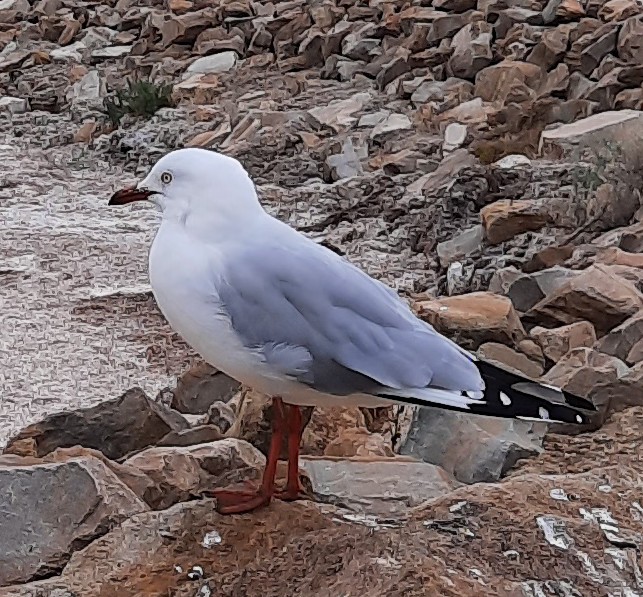
This is the seagull I took a pictrue of, that inspired the particular poem I thought I’d lost. I took the photo recently at an event I attended at St Kilda, South Australia. I’m happy with the photo, and am more than happy to share it!

Public Speaker, Writing

I have Transferable Skills

Dear Sir/Madam,

As a writer, I have many skills. I can type on a keyboard, faster than your average trained monkey, and my spoken language skills are infinitely superior to any parrot ever, living or dead.

I have written and read more and better poetry and short stories than probably any current member of the Australian Government. I know how to harness a pacer (harness horse), and how to prepare a Standard Schnauzer for the show ring.

I have a strong feeling for what makes a fine haiku or tanka, and am even able to write them as well! I can write a villanelle, a clerihew, and I am the person who first invented the Cordonostic Poetic Form (Google it).

My skills as an office worker were second to none in terms of slacking off whilst appearing busy, and I am proud to tell you that my Friday night drinks results surpassed what any man has probably ever achieved (my husband of over thirty years is offered as proof – his super pension is probably more than you are currently paid as a full time worker!)

All of the skills mentioned, are what are called transferable skills, and if you employ me, you will be amazed at what I do!

Yours sincerely,

Carolyn Cordon, Poet, novelist, short story writer, blogger, monthly newsletter editor, and so on …

I’m also as funny as a smelly fart in a crowded lift!

writing exercise

Creative Writing Workshop 1 – Acrostic & Cordonostic

For this exercise we will concentrate on two different Poetry Forms, Acrostic poetry, and Cordonostic Poetry.

Acrostic poetry has been around for a long time, and is much favoured by school teachers, I think, who find it an easy way for their students to get into writing poems. With this style, a single word can be chosen, and then the first letter of each line begins with each of the letters of the word, in order. So, with my chosen word – Autumn, the first line begins with the letter, A, the second line, U, the third line, T, and so on, all the way to the final letter, N.


You can choose to use just one word for each line, or you can write a short phrase, whichever you wish. But a poem is not a novel, so keep those phrases short. Autumn is my favourite season, and I enjoyed writing this poem, some years ago.


The poem just below is my own Acrostic poem, based on Autumn, my favourite season. Attendees are to choose one of the four seasons, for their own two poems.


Autumn

April comes along, trees

Until then heat struck, though

Tended well, and watered

Ultimately recover,

Managing leaf colour changes –

Nature’s amazing beauty …


Next Poetic Form – Cordonostic Poem We may have looked at this form previously, but I will clarify what it is all about:


The Cordonostic poem is based on syllable counts, with the first line having three syllables, the second line having five syllables, and the third and final line of the first stanza (verse) having seven syllables.


For the second stanza, start with seven syllables for the first line, then five syllables for the second line, and three again for the last line. For the third stanza, follow the stanza count as the first stanza, and for the fourth stanza, follow the second stanza, and so on.


Using the same season as you used for your first poem, write a poem, using words and phrases about your chosen season, bearing in mind the necessary syllable counts for each line. For the title of your poem, choose a word that is relevant to what you have written.

You don’t have to concern yourself about the poem title first though, often you need to finish a poem to see what it’s about, and so what the title could be.


This poem below was written after I had done some research into why leaves changed their colours, and I feel it is a fitting tribute to the wondrous way Autumn brings on this colourful phenomonem.


Photosynthesis

trees, their leaves

red, orange, yellow

lovely, chemically changed


trees and branches a backdrop,

and a gallery

for the leaves


wind-released

they drift off downward,

as ground becomes a carpet


then leaves, in decay, produce

nutrients, and trees,

fed, grow more –


trunk, and leaves

then blossom, perhaps

and after blossom, come seeds


and then, wondrous, welcome fruit.

the process goes on,

always will,


so long as

trees get the water

they need, fruit will come again.


autumn – colour, winter – rest

spring – blossom, then fruit –

nature’s way …


Thank you, I hope you have enjoyed this poetry session today, and I look forward to our next session!


Carolyn Cordon,


Writer, Poet, Community member, lover of Nature

www.carolyncordonwriter.wordpress.com


kittycordo@gmail.com


0418806490

poetry

Month of Poetry Over

The month of February was a wonderful month of poetry for me. I committed to writing a new  poem every day of the month of February. I didn’t actually write a new poem, as it turned out, but I did make up for it, by writing a new poem for the couple of days I missed. So the end result was that I did indeed write 28 poems, inspired by prompts given by a small group of poets.

These poets, organised a similar event in 2018, and I think they are planning the same thing for 2020. These lovely people were doing the same challenge, or as near as they were able to. It isn’t easy, to live a busy life, and do writing challenges like this at the same time, particularly if there are hungry children in the household, and it’s your task to keep them fed.

I’m not in that position, the only hungry creature I have to feed is our dog, and feeding Missy only involves giving her the correct amount of dog food, simple. Feeding children involves far more than that, that’s for sure. I suspect there is a poem in that, perhaps I’ve just given myself a poetry prompt?

Let me see …

Yes, not a clever poem here, but a new one, and written in a particular style, one I made up myself, quite a few years ago. I named this poetic style after myself, and called it the Cordonostic style of poetry. It’s one based on syllable counts, in this manner – first stanza, first line 3 syllable, second line 5 syllables, third line 7 syllables

Second stanza first line 7 syllables, second line 5 syllables, third line 3 syllables, third stanza first line 3 syllables, second line 5 syllables, third line 7 syllables, and so on for as long as you like. The poem I have written is not the most poetic example, but it will give you an idea on how it all goes.


*************************

imag0579

Why I have time for poetry


Feed the dog

dog food, scoop it up,

into her bowl, put bowl down –


eat it up Missy, good girl!

She chomps it all up

just like that!


Now, outside,

toilet break, back in –

never-ending tasks, daily.


She really is a good girl,

our dear Missy dog,

ageing now


getting grey,

older, and slower

but she’s still our lovely dog –


elegant, funny, hunter

a friend for us all –

canine pal.


Feeding kids,

and adults though, takes

more time. Something different


needed for evening meal

each day of the week.

Mother’s job


as a rule

even nowadays,

even if you’re a poet …