poetry

My Next Book Launch

I love book launches, especially when it’s my own book that’s being launched! I’ve never launched this kind of book before, a slim little volume known as a ‘chapbook’ or ‘chap book’.

These books are scaled down versions of poetry collections smaller both in size, and number of poems within the pages. Chap books are excellent for presenting your words to readers at a cost everyone should be able to afford, only $5.00! And they are so small and light, you can easily carry spare copies with you wherever you go, ready for a sale!

If you have a collection of twenty or so poems, all going together nicely why not consider putting them together for the interest of all! You can ask friends along for a coffee, talk about your collection, and then casually reach into your handbag or pocket, and show the book, just like that!

So a chap book doesn’t have to be ‘about’ anything, it can just be random poems, but I think it all holds together better if there is a theme, to be ‘about’ something. So what is my collection about? Well it’s about something painful, and very personal to me. It’s about my right ankle. In particular, it’s about my newly broken right ankle.

20191011_154049

This break happened at the end of September, I fell over and bang, two bones broken in my right ankle, and excruciating pain. Ambulance called, medical things done, hospital to hospital, to hospital, and finally home again. And then foot up, rest, rest, rest, healing happening all of the time.

With all of this rest, the obvious thing for me was to write poems about what was happening, both out of the window near the sofa I was reclining on to rest, foot up to reduce the swelling of my ankle. I wrote about being in hospital, the birds on our front lawn I could see, and a great many other things.

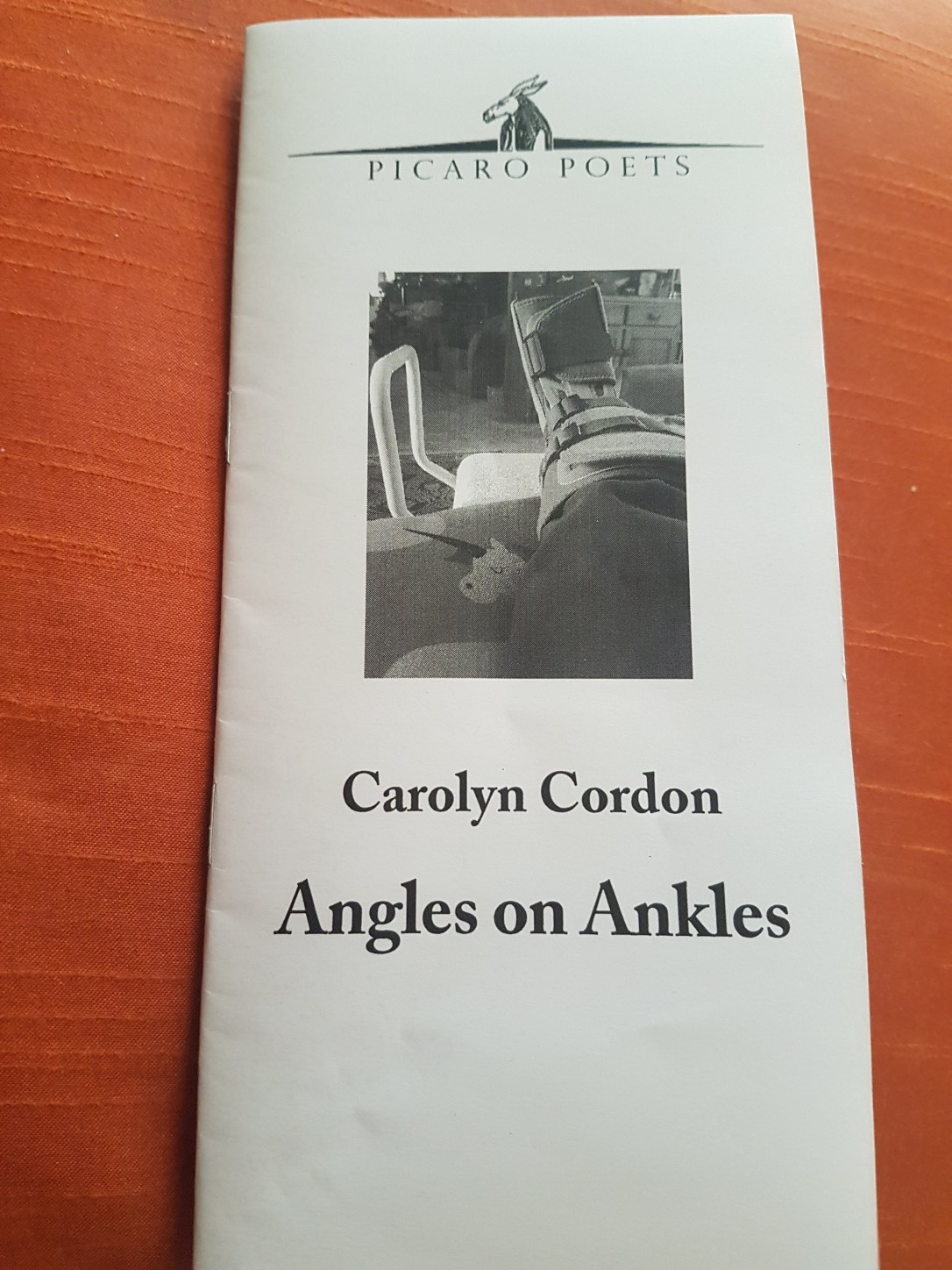
I in fact had over twenty poems, and I had a name for this proposed chap book as well. This book was going to be called “Angles on Ankles”, and it would cover a broad range of subjects related to my broken ankle. I know a publisher who publishes chap books as well as larger books, Ginninderra Press, so I approached them about possibly publishing this book. They were more than happy to have a look at what I’d written.

I sent the poems off, and suddenly, the book was done super quick, like it was meant to be!

20191122_122645-2

So once a new book comes into the world, the next step after sharing the book with close friends and family is often to launch the book into the greater world, to hold a Book Launch. So I’ve done some sharing with family and friends, and have now begun organising the book launch, at a venue that I know well, and that is happy to have poets there, doing their poetic things.

This venue is the Prince Albert Hotel, in Gawler, a hotel my writing group meets at every week, and one that is the venue for a monthly poetry reading, Gawler Poets at the Pub, held on the last Sunday of the month, every month.

So on the 29th of December, at the Prince Albert hotel, or the P/A as it is known by locals, I will be officially launching “Angles on Ankles”, reading some of the poems from the book, and talking about the whole ‘adventure’ of it all.

Poetry can be written about the most unlikely of subject matter!

inspiration, poetry, Story Ideas

My Next Book

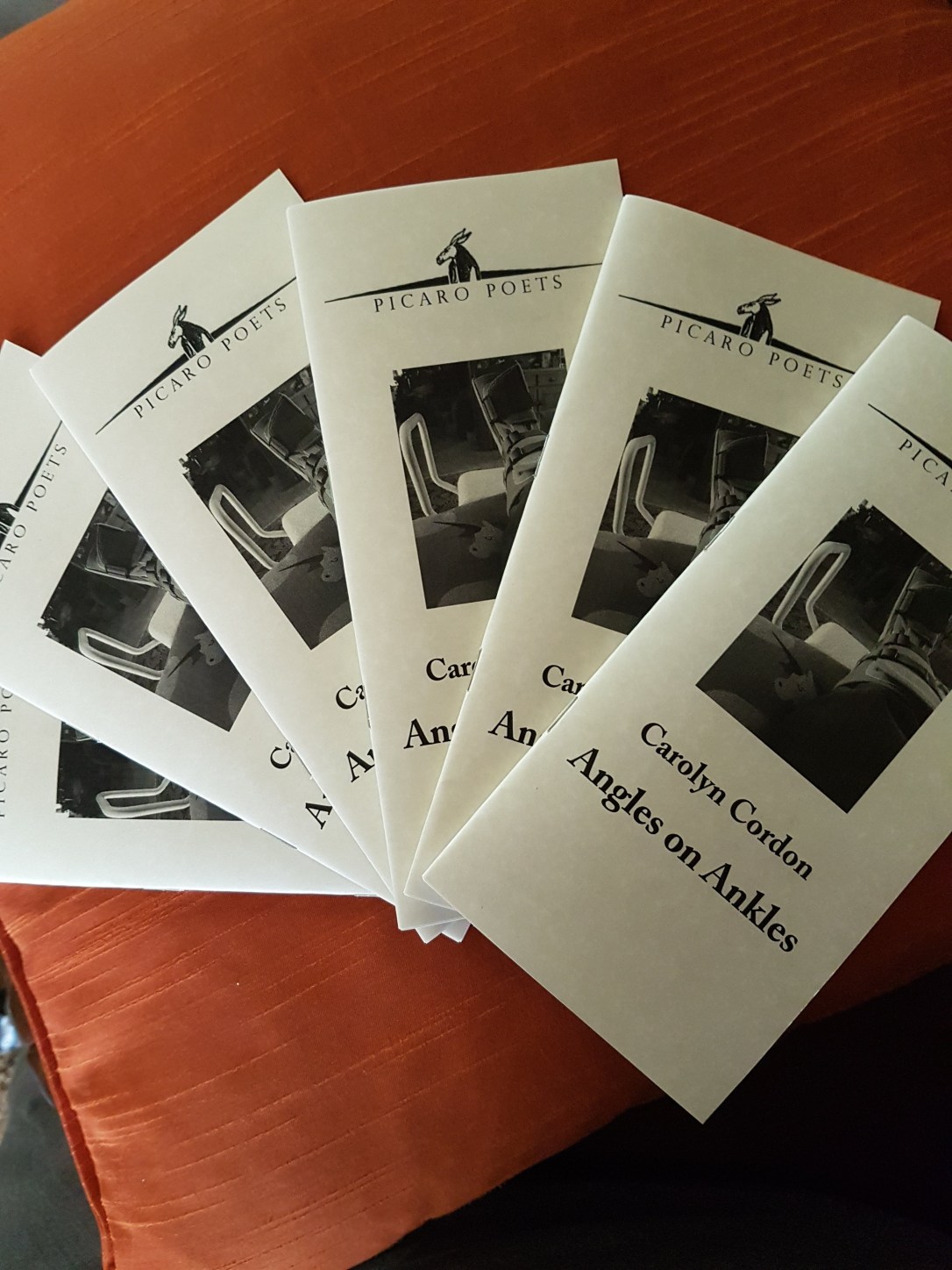
My next book is with the Publisher (Ginninderra Press), and it’s out now!  The book, “Angles on Ankles” proves to me, yet again, that writing about the less than lovely things that are in our lives, can give widespread interest to readers, and that has to be a good thing, right? Right!

20191122_122645

This book is a chap book, a small collection of poems I wrote after I recently broke my right ankle. I fell over, breaking two bones in the ankle. An ambulance took me to one hospital for treatment, then I went to another hospital, for more treatment for a day or so, and then I went, by ambulance again to a third hospital, where I had my ankle operated on, and fixed.

While I was in hospital a friend gave me a small notebook (many thanks Laura), and I wrote a couple of poems about my broken ankle experience. Then once I was home, and having to keep zero weight on my right ankle, I spent lots and lots of time sitting around, with my right foot up, and healing.

There are 21 poems in this book (more really, but I’m including the page of Senryu, as just one poem). So even though a writing friend didn’t think there was that much to write about breaking your ankle, I’ve certainly proved him wrong! I forgive him though, and have invited him (John Malone), to launch this book for me!

In this little collection, I mention pain, gratitude, friends, things that happened, or things I saw or was a part of during this time, as well as my thoughts about the whole process. When you have to sit and you’re unable to do much because you’re not supposed to put any weight at all on your broken ankle, it gives you lots of time to think.

And think I certainly did. I was fortunate, that my pain has been minimal, apart from the extreme pain when I fell over and did the actual breaking part of this drama, that was the worst pain I’ve ever felt. Once the ambulance and medical people got involved though, zero pain.

I was given extreme pain relief at the very start of all of this, when my ankle was initially treated, to get the ankle back into its proper position, and then after that at the hospitals, I was given medication so I could be comfortable, and pain free. Once I came home, I had the pain medication I picked up at the last hospital I attended, all good and all pain free now.

Some of these things are in this book, “Angles of Ankles”, and I hope I get many sales, and many hugs too, from people who want to have a copy of “Angles on Ankles”. I think this book would certainly be of interest to other people who have broken their own ankle, or perhaps sustained some other break of a limb. There are also thoughts about being in hospital, and about the resting and rehabilitation process.

This is the link about how to get yourself a copy of this book, if you’d like to. The book is not for sale by the publisher to people out of Australia, but as soon as my own copies of the book arrive, that I’m going to order, I will be able to see copies to people from anywhere, as long as those wanting a copy are prepared to pay for the postage costs, as well as actual book cost.

Because these chap books are so small, they only cost around $5, so that minimal size, and cost, means even with postage overseas, the cost isn’t high. And below, for your interest, is one of the poems from my book, I hope you enjoy it!

And if you have your own stories about injuries, and extended and unexpected times of rest and recovery, Please leave a message, I’d love to commiserate with you!


Tibia & Fibula


Boredom, 

ding! bang! 

people talking,

I remain here, 

still wriggling 

& wiggling my toes,

and learning a truth 

about time –

Hospital Time 

is not the same

as normal time, 

& plans made

by hospital staff, 

while worthy,

are as brittle 

& breakable

as a bone, 

or two bones 

at once.

inspiration, Writing

Some Words About Notebooks

If you’re a writer, I would expect you quite likely already know what I am going to write here, regarding notebooks. But there may be little things you have thought about before. If you’re not a writer, or don’t call yourself one yet, keep reading, you may one day join the ranks of the ‘world of writers’ and could find the information useful and interesting.

So, firstly, notebooks are excellent places for scribbling random ideas, thoughts, interesting now words, and a variety of other things. For instance, if you’re writing a novel, your notebook can be a useful place to scribble plot ideas, or some possible twists or red herrings for your novel. If you write non fiction, the notebook can be useful for noting down possible ideas for chapters, research, and so on.

I’m a novelist, (or trying to be one), but mostly I’m a poet, and I write random poems in the various notebooks I have. Going back to my novel-in-slow-progress, I have written down many short snippets for the novel I want to create, pieces that will go in the book, eventually.

But at the moment, I am putting together a chapbook, which is a small poetry collection of 15 to 40 pages. This collection has a theme, which is very personal to me. It is all about my right ankle, which I broke at the end of September this year. I want to have something in writing, looking at various aspects of what having a broken ankle is like.

So, to notebooks. When I was in hospital, a good friend of mine dropped in for a visit, and she gave me a present. This present was a notebook, which I was thrilled to receive. I have that notebook on the sofa next to me at the moment, and I was so happy when I opened it up earlier today, and looked inside.

You see, I’d already written 18 poems to go in my chapbook about my ankle, and thought that might be enough, but this notebook has two poems in it, that I can put into the chapbook! When I put all of the poems together, and include an introduction, that will make for a reasonable sized chapbook.

The great thing about notebooks is that when you have a few of them, you can go back and look in them, and discover interesting bits of writing that you’d forgotten about. I’ve found little gems of poems sometimes, and that is so thrilling, realising that yes, you are actually a fine poet, because that poem was yours!

If you want to put together a poetry collection, either a smaller chapbook, as I am currently working on, or a bigger poetry collection, always find as many of your notebooks as is possible, to bring some of your older poetic gems out into the public’s eye!

And sometimes those older notebooks can show you good things about how far you have come in your poet life, when you cringe at something you wrote many years ago, but you can now easily see ways to improve the earlier work, and turn it into something publishable.

Notebooks are also useful for writing down interesting and quirky little things that happen too. Sometimes these things can end up being funny little poems, fun to share with others when times call for amusing little things to share.

So if you are, or would like to be a writer or poet, get some notebooks, and use them as often as possible. That way you will always have material available for your writing, and you will always have something to do, write something in your notebook!

If you have any words of wisdom about notebooks, I;d love to hear it, leave a message here!

poetry, Uncategorized

Some Poetic Forms

There are many different ways to write poetry, or ‘poetic forms’. Here are a few you may have heard of, but never tried to write, or have written in the traditional form, but not in a new, stripped back form.

I like playing with different poetic forms, and am always happy to try something new, when it comes to my attention. My poetic attempts may interest others, or maybe they won’t it doesn’t matter. Trying these things out, using my own knowledge in different ways is good for my brain!

Give some of these forms a try yourself, and see whether your own brain feels pleasantly stretched in new ways! Firstly, I love sonnets, short poems of fourteen lines. They are distinguished by very strict rhyming schemes, in several different styles, as below:

  • Spenserian sonnet. 3 quatrains and a couplet – “abab bcbc cdcd ee”
  • english(shakespearean) sonnet. 3 quatrains of “abab cdcd efef” followed by a single couplet.
  • italian(petrarchan) sonnet. octave of “abba abba” then a sestet of “cdc cdc”

I have written in these three styles, having had some of my poems published in books, and online, and am proud of my work in the form. But today, I found a brand new form of the sonnet, and I hurriedly ‘gave it a go’!

This new form is the Monosyllabic Sonnet. I found it in an email, sent by a poetic friend, with details of his own poetry blog, https://playground.poetry.blog/ I strongly suggest you go there and explore the many poetic forms Paul has on display on his blog. I have a few of my own attempts at the forms Paul talks about, and encourage you to have a go too, and get involved in what Paul is doing, sharing poetry with the world!

So with the Monosyllabic Sonnet, the poet is to stick to the rhyming schemes for sonnets, as I have put above, but instead of writing in iambic pentametre, you are to write just one word of one syllable only, for each line, instead of longer lines of far more syllables for each line. You are also free to use the title of your poem to fill in more meaning to the poem, by indicating what it is about to aid with clarity.

Here is a new poem I have written to demonstrate what is meant:

On bringing meaning, by sharing your wisdom.


We

live, 

free 

give.


Wonder

much,

ponder 

such …


You 

know?

Do 

so!


Yell!

Tell!


If you like this poetic form please feel free to say so! If you wish, you can share your own attempt at writing a Monosyllabic Sonnet of your own.


Now a look at the short Japanese poems. The Haiku is the best know form of Japanese Poems. In the Western world, Haiku are often presented as being written in three lines, with five syllables in the first and final lines, and seven syllables in the middle line. This though is not quite what the Haiku is in its ‘native’ world, where the Haiku is an exceptionally short poem, usually of fewer characters than the English form indicates.

For this blog though, I am going to talk about a related poetry form, the Senryu. Where Haiku relates to poems written about Nature, and referring to the season, the Senryu is written about people, and can more than Haiku, be a funny poem, talking about perhaps a comical part of human nature.

The Senryu has the same form as Haiku, being a short poem, usually of three lines, short, long, short, as with the Haiku. I have written a new poem in this form, and hope you enjoy my words. Again, feel free to comment, and have a go yourself, if you feel so inspired! I love comments on this blog.


My Senryu:


Wisdom is

saying very little,

or staying mute …


Cozy Mystery, inspiration, Uncategorized

Talk to your Character

A dear friend of mine, Martin Christmas, is a fine poet, and even finer human being. He is a doer, an encourager, and as I said, a dear friend. Martin knows of my current troubles (a fractured ankle), and he is making sure my brain is still good, even if my ankle is busted.

I appreciate his effort, and his ideas that it might be a good chance to work on my written work. I agree that is should be a good chance for that, I’m comfortably seated, my laptop on my lap, with plenty of power available. So why is there no action going on with my proposed series of Cozy Mysteries, featuring Meredith, my main character.

I want this to happen, this series of books. I did lots of work on them earlier, perhaps when I was in hospital? Or it may have been before that. Hmm, before, I think. My mind is a little befuddled with all of the pain relief I had been taking, over the past fortnight … but anyway, I did manage to have a Talloola township thought while in hospital. I thought that I had to have a hospital in my town in my books, Talloola, and there had to be a murder in the Talloola Hospital, for Meredith to solve that crime.

I haven’t got much further than that thought, consciously, but I hope my subconscious mind may have been fiddling with the idea. To that end, I am going to do some free writing, chatting with Meredith, and see where (or if) things go. Meredith and I are good friends, she is a bit like the me I’d like to be, taller, prettier, a working woman, with a hunk of a football player as her love interest. (that bit is not me, my love interest is the wonderful man who is looking after me at the moment (and always).

So excuse me, while I go away and talk with my main character. If anything happens, and I sincerely hope something will happen, well, I’ll come back here and talk about it! I am very grateful to have Martin as a good friend, am hope I can live up to his (and my) expectations of what I am capable of doing!

Writing a whole series of Cozy Mysteries was a big project, but if I can live through a fractured ankle, and do it well, there’s no telling what else I can do, Ciao!