I am quite fond of the shorter poetic forms, such as Haiku, Senryu, and Tanka, which are 3, 3, and five lines respectively. All three are Japanese forms and while these forms in Japan are not exactly the same as Western poets understand those forms to be. It’s complicated.
There have been many wise words written about those poetic forms, and I’m not the person to have that discussion here. I am instead going to talk about a form called the Tetractys poem. It was ‘invented’ by a man named Ray Stebbings, in the year 2000.
On further research, I’ve actually found a mention of this poetic form back in 2016, when I actually left a comment on the website post it was described in. So my dodgy memory strikes again, ah well … It doesn’t really matter, I’m enjoying giving it a go again!
In that article, which you can read here, if you’d like to, it is mentioned the poem can take on a variety of extended further forms, but at the basic level, it is a short poem of five lines, with this syllable per line count: one, two, three, four, and ten syllables per line.
And in that article, it is mentioned the whole poem can be about a single thought, exploring it briefly, and then end. I wrote a couple of attempts at this poetic form, before reading that comment, so wasn’t thinking about that aspect of the Tetratcys, but these are my own tries at writing on of them:
Here tonight, I wonder if tomorrow, knows or even cares, how great this day was?!
I wrote this poem about the writing event I attended yesterday, and it was completely fabulous, so I wanted to immortalise it, forever! Or if not forever, then at least for now! The event was a presenter/poet who spoke interestingly about her writing, and public speaking. The guest was a well known South Australian ABC radio presenter, Annette Marner, who has two recent books, one a novel – “A New Name For The Colour Blue”, the other a poetry collection – “Women With Their Faces On Fire”. Both are awarded works of literature, and I heartily recommend you try to get a copy, and read them. Both are published by Wakefield Press.
This is the second poem I wrote:
This is not anything deep, meaningful, OK? It’s just maths, mashed with words. Art? Shrug …
So on re-reading my two poems, I can see both are in in keeping with what this poetic type is supposed to be, a single thought, explored a little. And to be honest and not wanting to brag, I quite like them both, but with a preference for the second one.
I’d love to know what you think about this form, and my words written about it. And of course, I’d love you to comment on my own poems, of course! Whether you like my work or not, the truth as you see it, is what I want to read!
The Non-Joys Of Writing, Then Accidently Deleting An Article …
Ah, it was such a great article this one. It went with a piece I’ll be presenting to the monthly writing group I attend, that I’d been asked to present a short workshop for. I knew what to do, and easily put together something, using material used for a previous workshop, for a different group.
So I did that, and then decided to share it online, but take it further, in the hope of attracting some interest, and so ultimately money. Money isn’t the reason I write though, it’s just a little bit of fun, if or when it comes. I write and share simply so others may learn from my words, or at least get something good from reading them!
This online site is a new one, I’ve just begun writing for. I’m enjoying it, and still exploring how it all works. Today I learnt how quickly one can make their work just disappear, poof! up in smoke! Well metaphorical smoke, not real smoke, so it wasn’t life threatening.
But it is so frustrating, to write something brilliant, and then lose it. It might not have actually been brilliant, but I think it was, and as it’s disappeared, nobody can prove me wrong … There was a bit of futher talk in it, about the Poetry Form I created about fifteen years ago, and there was a photograph at the head of the article, with a brand new poem in the said poetry form, about what was in that image …
But it’s all gone now, and while I have a hope it might simply be off in the online word of checking things and gaining approval, and it could appear again perhaps tomorrow, I don’t believe that to be true … Maybe I’ll put that particular image up on a blank page and try to write the poem again, or at least something like it …
Or maybe I could go back to the website, and search, looking back at what I’d been doing there, and find it again? Worth a try, right? Excuse me, I’ll do just that, and report back.
**************************
Back again and soooooooo happy! The article was there! It’s ‘awating review’, so neither in draft, or submitted. And I guess that means it will show up as being published after it has been reviewed. I hope so anyway.
In the meantime, I’ve copied the poem I wrote, and read it again. It’s is ok, but not as wonderful as I’d thought. I still think it will look nice though, printed out on a piece of A4 card, with the image. So I might do that later on, for who knows what purpose. Just to have it in that format I suppose. It could be useful if I were to do another workshop on Cordonostic poetry, which is what the workshop I’m doing Thursday is all about. Or I could print it out, and take it with me on Thursday to show, and read from then, as well as the poem on the workshop notes.
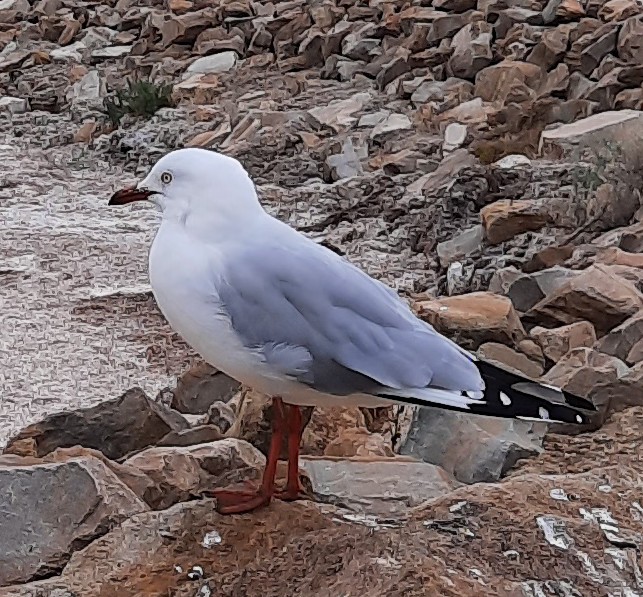
This is the seagull I took a pictrue of, that inspired the particular poem I thought I’d lost. I took the photo recently at an event I attended at St Kilda, South Australia. I’m happy with the photo, and am more than happy to share it!
If I call it a prose poem, does that make it an actual prose poem? There aren’t as many rules about what a prose poem needs to have. It’s not like writing a sonnet or a Haiku, where there are definite rules that you have to stick to fairly well, or it is definitely not one of those.
A sonnet that doesn’t rhyme at all, and is thirty lines long is not a sonnet. A Haiku that has 200 syllables and ten lines is not a Haiku. But a Prose Poem … it must be written in prose, where you continue from beginning all the way to the end of the line, and then the next line, to the next, and so on, until you’ve finished … And there have to be certain ‘poetic devices’. I’ve checked out some lists of ‘poetic devices’ and yes, my ‘prose poem’ has some of those happening, not a lot, but some …
How will I know if what I’ve written is a Prose Poem? Well if I, the poet say it is, then it is, that’s how I look at it. It may be a less than perfect one, but so be it. I’ve never claimed to be a great poet, just a good one, and having an attempt at a particular poetic form helps to make me get better at writing in that particular poetry from, from my experience. These days, if I write a Haiku, I know whether or not what I’ve written is any good as a Haiku. I may enjoy what I’ve written, but it might still fail as a Haiku, and that’s fine, as long as I don’t claim it as a Haiku.
So I guess for this discussion to get anywhere, I’d better put my Prose Poem here, so others can have a look and hopefully let me know how I may have done in the writing of a Prose Poem. Comments very welcome, in fact they are needed!
My slippers don’t look like these, but colourful images are nice on a blog post, aren’t they, so here we are …
And here is my Prose Poem, or at least the piece of writing I’m hoping is actually a prose poem … Let me know what you think about it, please, please, please!
Thanks John M … (a prose poem)
My slippers he says, why not write a poem about slippers. He’s not here when he says it, or I’m not there – one of them – or both, I guess – he says it in words, online, and I read it when he is somewhere else, in another time, we are both time-travellers, wordsmiths travelling from past to future, with only brief moments in time when we are both in the same place, at the same time, talking together in actual spoken words, and sometimes, hugs might happen … They have in the past, and I’m sure will again in the future.
Anyway, back to the slipper. Because he wasn’t there, he didn’t see the way my entire body shuddered, ever so slightly, just a small and brief shudder, like a tiny sneeze that my whole body took part in, not just my nose and upper body. That shudder began on the 28th of September, and has been sitting inside of me, escaping momentarily, then disappearing, then coming back, over and over, unseen and almost unfelt. But it’s there, it may always be there, waiting.
So I write about my slippers, and ignore the thoughts that scurry around in my head, and the small shivers that go from head to toes and up again, slight shivers, that are actually shudders, at my memories both remembered and hidden away. It started with my slippers, my inside slippers. On the day I wore my inside slippers outside. A mistake, I know that now. A painful mistake.
I have written about the results of the mistake, but on searching see the cause of that mistake, the actual reason, or part of it anyway, is not even mentioned in the book of poems I wrote about it all … Why is it so? As a person more famous than I, used to ask. Why is it so? Has my brain closed off to the main cause of it all, to protect some inner part of my psyche? I don’t know. But I am going to open up here, and briefly speak on the subject, the cause, the reason why it was so.
Slippers. Wearing inside slippers outside. Trip, fall (clumsily, painfully, twistedly). Slipper falls off, pain increases, yell for help, it arrives, then more help, ambulance, hospital, pain relief, another ambulance and hospital, repeat – lots of pain relief … Culprit slipper brought inside at some stage, not by me. And so many months later, I am healed, foot no longer too swollen to wear slipper, and healed enough, easily enough (operation a great success) but still not wearing those slippers, not even inside …
Not wearing my outside slippers outside either … Two pairs of slippers, neither pair being worn. And yes, it is Summer now and hotter, some days anyway, but even so … I’ve been wearing something on my feet with my socks when I go outside to do things – boots or runners, but definitely not my slippers, either pair … They, my inside slippers, are still holding onto bits of dried grass, picked up when I fell, and then managed to drag myself a short distance on the back lawn, before I was able to get the wherewithal to call for help. It would be an easy task, now, to bush off that dried grass. Simple. You’d think so, wouldn’t you? But life doesn’t always go like that. Life is, other …
If it was that simple, it would have been done. I would have done it. Wouldn’t I? But I haven’t. Why the heck is THAT so? Laziness is one possibilty, for sure, that and just can’t be bothered, but it won’t be that difficult. Wouldn’t be that difficult … So will I do it, will I go and get those inside slippers that I once wore outside, and paid for my error by breaking my ankle? Will I ever brush off that dead and dried out grass, make my slippers clean again, and wear them? A shudder pretending to be a shiver … No, not yet, I’m not ready for that, not yet. Maybe tomorrow, next week, next year? Or maybe never.
Yes, I currently have a very much scaled back life at the moment. I recently broke my right ankle, and am in recovery mode, having been told by the surgeon who operated on my ankle, to stick to zero weight bearing. This means I currently am spending most of my time resting my ankle, with it up high, to reduce swelling, and increase healing (I hope).
I could have been using this scaled back time to work on a larger writing project, but my brain and inclination are not heading in that direction, I’m feeling much more interested in poetry right now, so that’s where my writing is going. That and blog posts, such as this one. Oh, and some thoughts about Stoicism and how it can apply to life situations.
That is being kept to myself at the moment, with notes on my laptop that are definitely not for publication as they are, and not for quite some time later, anyway. They may appear in part in a much longer non-fiction tome, sometime.
Anyway, scaled back poetry interests me – I love Haiku and Senryu, the Tanka as well, and I have recently found (online), a scaled back version of writing sonnets. I love sonnets, a mere fourteen lines, in particular rhyming schemes, and beautiful thoughts can be expressed. This new (to me) form though has only one syllable per line, though if maintains the sonnets 14 line needs, as well as the rhyming scheme.
I wrote more about this on a previous blog post, here, If you wish to look more closely into this sonnet form, called the Monosyllabic Sonnet, visit the blog post. I write about sonnets in general and this form in particular, with an example.
I wrote a new piece of text today, based on something in this room, something that happens often in this room, the one I have been spending so much time in, as I work on recovering from my accidental fall and consequent broken bones. I have presented the words I wrote, again in a one word and syllable per line, and I think it looks and reads quite well. I could be delusional, who knows, and at the moment, amusing myself is my main desire …
So here it is, an new thing that may or may not be a poem, which I will call “My Obs”. The term “obs” loomed large in my life when I was in three different hospitals recently, with my obs being taken by nurses often during both the day, and through the night too. Their role is to make sure I’m OK, taking my pulse, heart rate, temperature, and oxygen levels (or I think that’s what they were doing).
Anyway, as a writer and poet, my observations are my ever ready sources of writing material, so I’d be a fool not to use them! and here is today’s “My Obs” poem, my first ever, THE first ever:
There are many different ways to write poetry, or ‘poetic forms’. Here are a few you may have heard of, but never tried to write, or have written in the traditional form, but not in a new, stripped back form.
I like playing with different poetic forms, and am always happy to try something new, when it comes to my attention. My poetic attempts may interest others, or maybe they won’t it doesn’t matter. Trying these things out, using my own knowledge in different ways is good for my brain!
Give some of these forms a try yourself, and see whether your own brain feels pleasantly stretched in new ways! Firstly, I love sonnets, short poems of fourteen lines. They are distinguished by very strict rhyming schemes, in several different styles, as below:
Spenserian sonnet. 3 quatrains and a couplet – “abab bcbc cdcd ee”
english(shakespearean) sonnet. 3 quatrains of “abab cdcd efef” followed by a single couplet.
italian(petrarchan) sonnet. octave of “abba abba” then a sestet of “cdc cdc”
I have written in these three styles, having had some of my poems published in books, and online, and am proud of my work in the form. But today, I found a brand new form of the sonnet, and I hurriedly ‘gave it a go’!
This new form is the Monosyllabic Sonnet. I found it in an email, sent by a poetic friend, with details of his own poetry blog, https://playground.poetry.blog/ I strongly suggest you go there and explore the many poetic forms Paul has on display on his blog. I have a few of my own attempts at the forms Paul talks about, and encourage you to have a go too, and get involved in what Paul is doing, sharing poetry with the world!
So with the Monosyllabic Sonnet, the poet is to stick to the rhyming schemes for sonnets, as I have put above, but instead of writing in iambic pentametre, you are to write just one word of one syllable only, for each line, instead of longer lines of far more syllables for each line. You are also free to use the title of your poem to fill in more meaning to the poem, by indicating what it is about to aid with clarity.
Here is a new poem I have written to demonstrate what is meant:
On bringing meaning, by sharing your wisdom.
We
live,
free
give.
Wonder
much,
ponder
such …
You
know?
Do
so!
Yell!
Tell!
If you like this poetic form please feel free to say so! If you wish, you can share your own attempt at writing a Monosyllabic Sonnet of your own.
Now a look at the short Japanese poems. The Haiku is the best know form of Japanese Poems. In the Western world, Haiku are often presented as being written in three lines, with five syllables in the first and final lines, and seven syllables in the middle line. This though is not quite what the Haiku is in its ‘native’ world, where the Haiku is an exceptionally short poem, usually of fewer characters than the English form indicates.
For this blog though, I am going to talk about a related poetry form, the Senryu. Where Haiku relates to poems written about Nature, and referring to the season, the Senryu is written about people, and can more than Haiku, be a funny poem, talking about perhaps a comical part of human nature.
The Senryu has the same form as Haiku, being a short poem, usually of three lines, short, long, short, as with the Haiku. I have written a new poem in this form, and hope you enjoy my words. Again, feel free to comment, and have a go yourself, if you feel so inspired! I love comments on this blog.




 Carolyn Cordon - Creative