poetry

Working On My Next Big Thing

I know I’m actually supposed to be writing a novel, but I have to admit to myself that I’m not a novelist, not really, at heart, and in my mind, I’m a poet. So that said, even though I have a partly written novel in need of further words written, and some kind of sense made of the various written sections, I am not feeling committed to seeing that novel in print, even though I’m still thinking about the characters.

I’m a poet, so these past few days, I’ve been working on putting together my next possible poetry collection. I’m still conscious of my undue haste in trying to get a different poetry collection published, and had it rejected by the chosen publisher (deservedly so, I agree). But this collection, I hope, won’t be rejected, I like this collection of poems.

Many of the poems in this new collection are very new poems, there are no poems dragged out from years ago, and I’m enjoying the idea of getting some things I’ve written in draft form, in the past year or so, ‘scrubbed up and polished’ to be fine poems, living up to my hopes when I first came up with them.

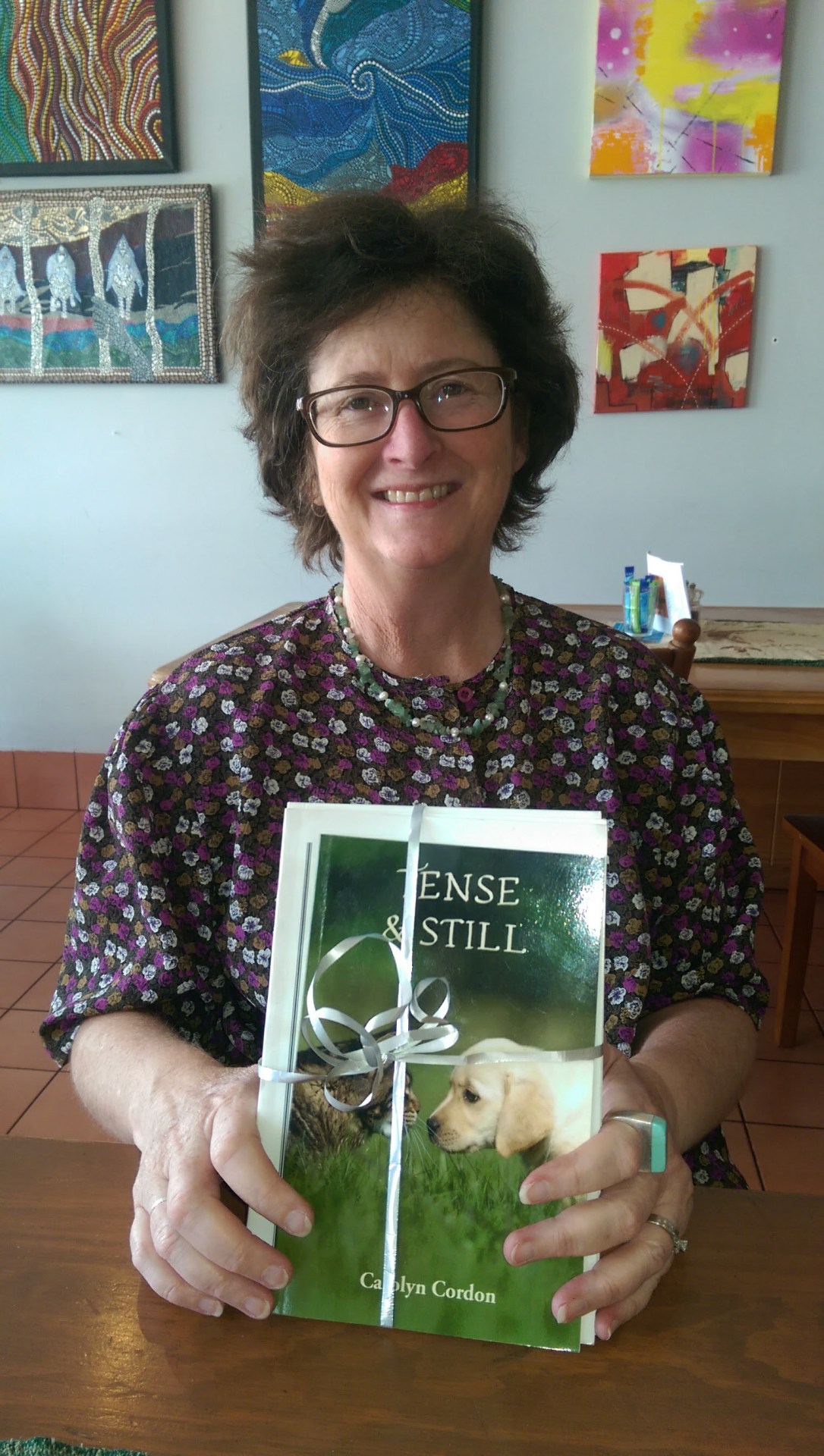
This new collection is contemporary, dealing with people, for the most part, with a few animal/nature related poems, that may or may not make it to the final collection. I’ll wait and see how I feel about that much later on. My previous poetry collection was all about the animals I’ve known in my life, from pets, to wild animals to the creepy crawlies around where I live. I enjoyed putting together that collection, titled “Tense and Still”, It would be great if this current work in progress could be as good as, or better than that one.

One thing I’m definitely going to do this time, is to have other poet friends read this new collection, to give me feedback, before I send it to a potential publisher. That’s one of the reasons the previous ‘collection’ met such an ignoble end, it was a mish-mash, a jumbled mess, that looked exactly like that, it indicated a confused person, who didn’t pay enough attention to, or care about her work and words on that occasion.

This time will be very different. I have a title I’m fond of, that others have agreed is an arresting title for a collection. I have quite a few poems I feel are exceptionally good, I have a bit of a strand of meaning running through the ideas in the poems, and I feel I will be able to hook the poems to the strand, so it flows along in good and poetic ways.

At the moment, even though I have the poem titles in a particular order, I am not set on that. My next step, after looking for and typing up another few poems I have around my papers/notebooks, is to print out all of the poems, and have a good read of them all, and make piles of related poems.

Then I’ll leave it for a day or so, then take another look, think about it all, and see if I feel I’ve got a collection that ‘works’. Then I hand it over to those few poet friends, for feedback. I’m hoping that within a year, this will be a poetry collection, written, submitted, and published, then launched.

Keep an idea here, for further news. And please feel free to ask me about this process, if there’s anything you’d like to know.

Writing

Wasting Words, or Just Wasting Time?

I am a poet, a blogger, a Facebook User, I use Twitter, I’m writing a novel, I write short stories (sometimes), and I put out a monthly newsletter for my local town. I enjoy doing all of those things, and some of them I do every single day – the Social Media pieces of writing, commenting on Facebook, and tweeting on Twitter. I blog at least every coupe of days, and often post a new blog post once a day or more. I am a writer.

I’m a member of a writing group that meets once a week, and another group that meets once a month, and I will always write something new either at, or for those groups. The thing I most want to be though, I think, is a published novelist. So why don’t I write a novel?

I sort of am, writing a novel. The writing I do at the weekly writing group, is often a short piece that will go into my novel, eventually. I think on the writing prompt for the session, and think on my main characters from my novel, and about what I’ve written so far for my novel, and I write, and there is another fragment of writing for that novel I’m working on.

But is this a way to actually write a novel, I wonder? I have short pieces, perhaps 150 to 300 words, and that’s it. a week or so ago I actually managed to write a new piece for my novel that followed directly from the piece I wrote the week before. I happened to have the same notebook with me, and so it was simple to look at the previous week’s work before starting on the writing exercise for that day.

imag0588

I’ve used various notebooks for the writing exercises, and I’ve written other parts of my current work in a file on my laptop. I’ve written other pieces on my phone, other parts on our PC. If I gathered up all of those pieces of writing of that novel, I’m not really sure how many words I’d have. It may be 50 to 60 thousand words. But am I putting all of those bits of writing together? No, I’m not, I’m happily doing other kinds of writing, the blogging, the comments on Facebook, the tweets on Twitter, and the poems at other times.

I’m writing words, but as the title of this blog suggests, I’m wasting my time, if that is what my writing aim is … Or am I? Living my life, thinking about things, being a part of my various communities, these all add to my knowledge of life, and five me ideas about things. And surely writers have to have interesting things to write about, ideas, thoughts.

So perhaps I’m not wasting my words, perhaps I am writing that novel, and perhaps this novel, these characters, will finally make it out into the real world. What do you think? Will Meredith and Travis, my main characters, beat the bad guy, and then finally commit to a relationship together? What do you think?

poetry

Creative Writing 5 – Poetry Presentation/Performance Poetry

Another aspect of poetry

So today, we are going to explore ways to better present our poetry to others. Poetry in a book is heard by the listener in the way they read it. That reader may simply read word after word, after word in a monotone boring way. They may put lots of emotion into the words they read and hear inside their head and find the words exciting because of the effort they put into it.

What we are going to do is to present our poems in ways that will excite the audience, and I hope excite ourselves too. I’m sure you’ve all done some work in presenting things to an audience, but if you haven’t here are some ideas and clues on how to help make it an exciting event for the audience who is listening to you read your poem.


Poetry Out Loud!

We are going to firstly wake up ourselves and our voices. Stand up, make a little room for yourself. Spread your arms out to the left and right, slowly twist your body around, one way then the other repeat, repeat. Next, make fists, then spread your fingers out wide, repeat twice, slowly. Then shake your arms around while marching on the spot. OK, enough hard work, we’re ready to move onto the actual voice work.

In a clear and firm voice, say this:

La la la la la la la la la la Woohoo! Woohoo? Woohoo! Woohoo? Woohoo! La la la la la la


Give Your Poem All You Can!

A poem needs time to go from one person on to the next person, from you to your audience. Reading your poem slowly, and 2/3 speed or sometimes even slower, gives the listener time to properly take in your words, to think on the thoughts being presented.

You are now ready to read your own poem! Find an area in the room, imagine your audience and prepare to read your poem to your imaginary audience, putting into your reading all of the emotion your words call for.

Use your body too, hands, arms, whatever the poem calls for, gestures and so on as appropriate for your poem. In that same clear and firm voice, read your poem – clear – firm – slow – Don’t be afraid to really put on a performance, that is what we are doing here, performance poetry, and that’s what the audience is here for!

I want you to use your voice to wrap up your new poem, in love, with emotion and meaning, so any audience who listens to you read your poem, truly understands the great worth of your fine words!

I will present the poem I wrote earlier this week, that I brought along yesterday with the notes for that session. I did a little editing after I did a practise reading earlier today, and I hope I made it better. Reading your work out loud is always a valuable method for finding the places where your poem doesn’t quite flow the way you and the audience want it to.


Imagine me performing this poem, with actions and with emotion, giving my all, so you will feel my words in your head and in your heart.


image00000084

What is Freedom?

If the question blazes down on me like the sun,

blinding bright so I can barely see a thing

I do not know what Freedom is …


If the question sticks in my throat, making me cough,

unable to say a single word at all

I do not know what Freedom is …


If the question is like a flood of people

drowning me with their constant demands

I do not know what Freedom is …


If the question is a weight on my shoulders

burdening me so I cannot dance and play

I do not know what Freedom is …


But if my life is full of love, joy and wonderful things

I am able and allowed to do, I no longer need to ask –

then and only then, do I truly know what Freedom is!


© Carolyn Cordon 2016


OK, know it’s your turn, slow & steady with emotion and meaning!


Thank you everyone, I hope you’ve found this useful.


Carolyn Cordon offers sincere thanks to Martin Christmas, Poet, Performer, and fine friend. He is the person who showed me how to perform my own work with emotion, and with heart, and he will be forever be in my heart too.

poetry, writing exercise

Creative Writing Workshop 2 – Writing an Ode

An Ode is a celebration, a lyrical poem praising something. It can be something wondrous, or it may be something so-so that the poet can make wondrous through their words in praise of it. John Keats has a well known Ode – Ode to a Grecian Urn, and another titled Ode to a Nightingale. They are both fine Odes, but today we are going to look to more contemporary times with the odes we will write. When writing a ode, you have permission to go overboard with the imagery and metaphor!


And that’s it. With an Ode, you can rhyme or not, as you choose, you can be as silly or serious as you wish, it’s all up to you and your thoughts. The most important thing is to go beyond the obvious, and take your love of your chosen thing as far as you can, lauding it all the way to the sky and stars!

Ode to the Op Shop

Oh wondrous home to much –

glorious treasure trove  

Of love and possibility

Staffed by precious volunteers

Those whose freely-given time benefits many –

Small-time hoarders like me,

Or those in the know who buy much

Then onsell to many

But a delight for those searching

Looking for their next fashionable fancy

And when finding such, our joy

Is met with smiles.

Named junk shops by some

Those who think a label

Rather than a look, is the fashionable thing

But limited new ‘range’ to choose from

Is just the so-called latest thing

Ignoring the clothes of yesteryear –

The best of their time, made best again,

At a bargain price, when payment gives back

To those who have little.

My wardrobe & drawers

Are filled with many found treasures

from within your worthy walls

And walls of other stores like you,

Clothes that have lived a life

Before they came to me,

That could tell such stories!

Each item willingly given up

To be worn again with pride and thanks

Is testament to the love shared

In one of these slices of community

And humanity, wonderful Op Shops,

Shared spaces, filled with memories of the past

And hopes for the future.

Op Shops, oh how I love you, Op Shops

Fine resting places for my unwanted items,

That I bring to an Op Shop such as you,

Knowing that when my need for them is over,

They will be with those who understand

The Op Shop’s fine and long tradition

And who realise the wonders to be found

In the taking up of clothes, both pre-worn and pre-loved,

Knowing the impermanence of such clothes

And relishing it. What has been with one,

Can be again with another, and once lived with

For a while, can move on again, via an Op Shop

And so it goes on, treasure donated by one

Found by another, one who in time,

May donate again, and so it goes,

Op Shops building community,

Community loving Op Shops,

All sharing the love, and the clothes.

We are many, those who share the love

of these wonderful Op Shops –

Treat them well, care for the treasures

found within, and share them with others

at an Op Shop when the proper time comes …

                                                         © 2017 Carolyn Cordon


You could choose to write an ode to your football team, your pet, a flower, anything, just as long as it’s something you love and have many thoughts about!


So think of the subject of your Ode, and start writing down thoughts about why you love it so much, then get working!


Carolyn
Carolyn Cordon, kittycordo@gmail.com

writing exercise

Creative Writing Workshop 1 – Acrostic & Cordonostic

For this exercise we will concentrate on two different Poetry Forms, Acrostic poetry, and Cordonostic Poetry.

Acrostic poetry has been around for a long time, and is much favoured by school teachers, I think, who find it an easy way for their students to get into writing poems. With this style, a single word can be chosen, and then the first letter of each line begins with each of the letters of the word, in order. So, with my chosen word – Autumn, the first line begins with the letter, A, the second line, U, the third line, T, and so on, all the way to the final letter, N.


You can choose to use just one word for each line, or you can write a short phrase, whichever you wish. But a poem is not a novel, so keep those phrases short. Autumn is my favourite season, and I enjoyed writing this poem, some years ago.


The poem just below is my own Acrostic poem, based on Autumn, my favourite season. Attendees are to choose one of the four seasons, for their own two poems.


Autumn

April comes along, trees

Until then heat struck, though

Tended well, and watered

Ultimately recover,

Managing leaf colour changes –

Nature’s amazing beauty …


Next Poetic Form – Cordonostic Poem We may have looked at this form previously, but I will clarify what it is all about:


The Cordonostic poem is based on syllable counts, with the first line having three syllables, the second line having five syllables, and the third and final line of the first stanza (verse) having seven syllables.


For the second stanza, start with seven syllables for the first line, then five syllables for the second line, and three again for the last line. For the third stanza, follow the stanza count as the first stanza, and for the fourth stanza, follow the second stanza, and so on.


Using the same season as you used for your first poem, write a poem, using words and phrases about your chosen season, bearing in mind the necessary syllable counts for each line. For the title of your poem, choose a word that is relevant to what you have written.

You don’t have to concern yourself about the poem title first though, often you need to finish a poem to see what it’s about, and so what the title could be.


This poem below was written after I had done some research into why leaves changed their colours, and I feel it is a fitting tribute to the wondrous way Autumn brings on this colourful phenomonem.


Photosynthesis

trees, their leaves

red, orange, yellow

lovely, chemically changed


trees and branches a backdrop,

and a gallery

for the leaves


wind-released

they drift off downward,

as ground becomes a carpet


then leaves, in decay, produce

nutrients, and trees,

fed, grow more –


trunk, and leaves

then blossom, perhaps

and after blossom, come seeds


and then, wondrous, welcome fruit.

the process goes on,

always will,


so long as

trees get the water

they need, fruit will come again.


autumn – colour, winter – rest

spring – blossom, then fruit –

nature’s way …


Thank you, I hope you have enjoyed this poetry session today, and I look forward to our next session!


Carolyn Cordon,


Writer, Poet, Community member, lover of Nature

www.carolyncordonwriter.wordpress.com


kittycordo@gmail.com


0418806490